Start cooler than feels sensible.
A runner creates more heat than a cyclist at the same air temperature. If you feel perfectly warm before moving, you are often overdressed once the pace settles.
The first ten minutes are not the whole run. Dress for steady movement, then add small pieces for the parts that still bite:
- Hands and ears in cold wind.
- A light shell when rain is cold or persistent.
- The walk home if you stop far from shelter.
- Use effort as the main adjustment. Easy jogs need more clothing than hard workouts.
- Keep removable items small: gloves, headband, buff, light shell.
- For out-and-back runs, check the return direction. A tailwind out can become a cold headwind home.
Running clothing cheat sheet
This table assumes a steady run. Slow recovery, tired legs, rain, or long stops make you colder. Tempo work and hills make you warmer.
| Feels like | Typical kit | Bring or check |
|---|---|---|
| 25°C+77°F+ | Light singlet or tee, shorts, cap or sunglasses. | Water access, sunscreen, shade on the route. |
| 18-25°C64-77°F | Short sleeve or singlet, shorts. | Mostly simple kit. Check sun, humidity, and run duration. |
| 12-18°C54-64°F | Short sleeve or light long sleeve, shorts. | Thin gloves or headband only if windy or easy-paced. |
| 7-12°C45-54°F | Long sleeve, shorts or light tights. | Gloves, headband, light shell if wind or showers are likely. |
| 0-7°C32-45°F | Long sleeve, tights, gloves, headband or beanie. | Wind layer if exposed, buff if cold wind, surface check if icy. |
| Below 0°CBelow 32°F | Thermal top, tights, warm gloves, head/ear cover. | Daylight, warm gloves, head/ear cover, surface check. |
Runners usually need less clothing than cyclists because there is less speed-induced wind chill and more constant heat from the effort.
Rain and wind decide the extras.
Light rain on a mild run can be fine in breathable kit. Cold rain is different. Once fabric is wet and wind picks up, hands, ears, and core temperature become the problem.
- If rain is brief and mild, a shell can be more annoying than helpful.
- If rain is cold or persistent, bring a light waterproof or windproof layer.
- If wind is strong, protect the front of the body and cover hands early.
- If you may stop far from home, dress for the walk back too.
Dark runs need a separate check.
Visibility is not clothing in the strict sense, but it belongs in the same pre-run decision. Dark, fog, wet roads, and low sun all change how visible you are to drivers and other path users.
- Use reflective details or a light when roads, crossings, or shared paths are part of the route.
- Check whether the return half is after sunset, not just the start.
- Pick brighter kit when rain or fog makes contrast worse.
How Route Companion adjusts for running
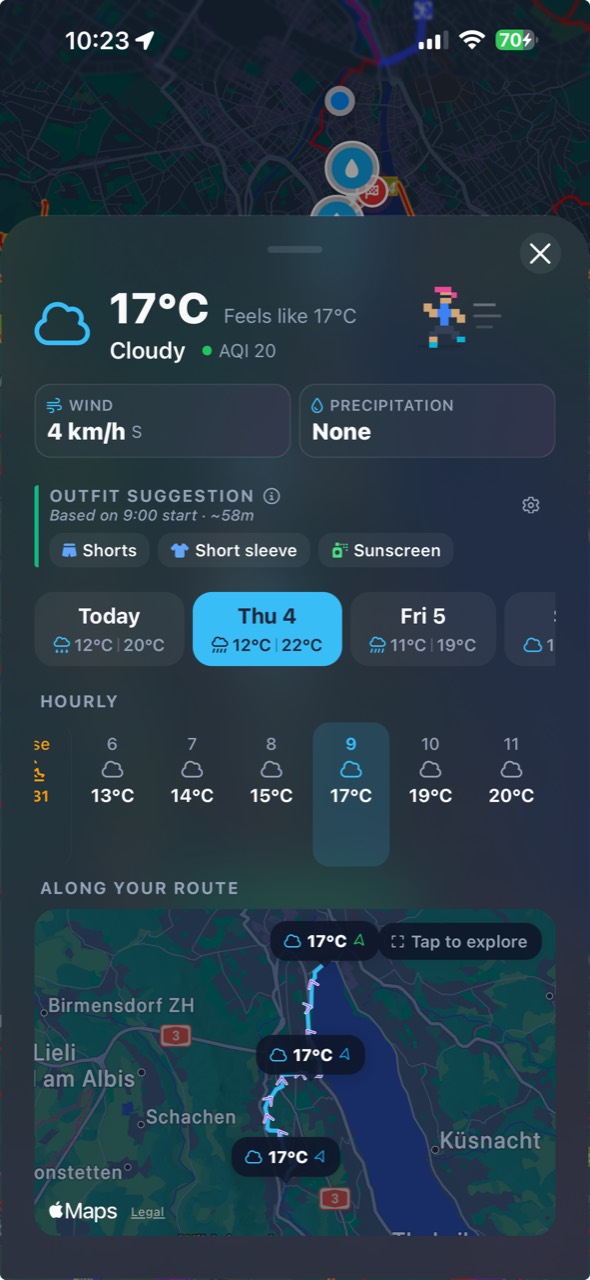
Route Companion uses the same route weather idea for running: weather by location and expected time, not just one city forecast. The outfit model reads feels-like temperature, wind, rain probability and amount, UV, daylight, fog, activity mode, and your warm/cold preference.
Running mode is not a renamed cycling mode. It assumes runners generate more heat and are less affected by speed-induced wind chill, so the clothing thresholds are lighter. Any extra wind-chill nudge on top of the forecast's feels-like is applied at about half the cycling strength, because runners move slower and create less of their own airflow. It also removes cycling-specific pieces like gilets, arm warmers, leg warmers, overshoes, and bike lights.
Use it as a pre-run sanity check, especially when the weather changes across the route or between the start and the return.
What the app uses
Running mode uses the same route weather pipeline as cycling, but the outfit rules change. It assumes runners generate more heat and are less affected by speed-induced wind chill, then checks feels-like temperature, wind, rain probability and amount, UV, daylight, fog, and your warm/cold preference.
It does not know pace plans, trail surface, shelter, or whether you will stop for long. Those still belong in the final call before leaving.
Reference notes: Route Companion uses forecast data to calculate the route weather shown in the app. For background on terms like "feels like" and wind chill, see the UK Met Office and NOAA / National Weather Service.