Use ranges, not magic numbers.
Fuel depends on effort, duration, heat, gut tolerance, and what you ate before rolling out. The point is not to hit a perfect number. It is to avoid underpacking and then trying to make one bottle and a stale bar cover a ride that needed more.
| Ride | Carbs | Fluid | What to watch |
|---|---|---|---|
| Under 60 min | Often optional if you ate normally. | Water as needed. | Bring something small if the ride can turn into two hours. |
| 1-2.5 hours | About 30-60 g/hour for steady endurance work. | Roughly 0.4-0.75 L/hour depending on weather and sweat. | One bottle with mix plus a snack is often enough. |
| 2.5+ hours | Often 60-90 g/hour if your gut is trained for it, using a glucose-and-fructose mix (about 2:1). | Expect more bottles in heat or humidity. | Plan water stops before you need them. |
| Race or very hard ride | Higher targets can work, but should be practiced first. | Match fluid to sweat rate as closely as practical. | Do not test a new drink mix or gel stack on the event day. |
Two notes on fluid. In real heat a hard effort can push past 1 L/hour, so do not treat any single number as a hard ceiling. But do not force fluid either: drink to thirst and aim to replace what you lose, because over-drinking plain water carries its own risk. And once a ride turns hot or long, the salt matters as much as the water. Add a pinch of sodium or an electrolyte tab so plain water is not all you take in.
The plan has to survive contact with the route:
- Pick a carb target you can stomach.
- Decide how many bottles you can carry.
- Look for the first place the plan breaks. That is where the stop belongs.
A cheap drink mix is not a downgrade.
You do not need expensive gels for every normal ride. Packaged sports nutrition is convenient, especially for racing, but sugar and salt can cover a lot of training days perfectly well.
Simple bottle mix
For a 500 ml bottle, try 30 g table sugar, a small pinch to 1/8 tsp table salt, water, and lemon or squash for flavor. For 750 ml, use about 45 g sugar and a slightly larger pinch of salt. Shake it hard, taste it, and make it weaker if your stomach objects.
Table sugar is sucrose, which breaks into glucose and fructose. That mix matters above roughly 60 g/hour. Glucose on its own saturates the gut's absorption pathway near 60 g/hour, so reaching 80-90 g/hour needs a second sugar (fructose, usually about 2:1 glucose to fructose); the rest just sits in your stomach. If you are chasing high carb targets, train your gut gradually and do not assume the strongest bottle is the best bottle.
- For easy rides, lighter mix plus real food is often nicer than syrup.
- For hard or long rides, put some carbs in bottles and some in food.
- For hot rides, mark refill points before the exposed sections.
- For remote routes, carry backup calories you can eat without water.
Pack enough without filling every pocket.
Use a mix of quick fuel and normal food. Gels are compact and predictable. Bananas, rice cakes, bars, cookies, sandwiches, and sweets can be easier to keep eating on long steady rides.
Save quick fuel for the times when chewing is annoying: climbs, hard group riding, or the last tired hour. Use solid food when the ride is steady enough to eat properly. Then add one item you do not plan to eat. That is for the closed shop, wrong turn, longer-than-expected headwind, or friend who underpacked.
Fuel planning is also stop planning
Most failed fueling plans are not spreadsheet failures. They are logistics failures: the shop is closed, the fountain is behind you, the next town is farther than it looked, or the hot section starts before the refill.
- Mark water stops before long climbs and exposed hot sections.
- Check whether a route has a long gap between villages.
- Carry more dry calories when refills are uncertain.
- Use gas stations, cafes, supermarkets, public taps, cemeteries, and train stations depending on the country.
This is where route-aware planning matters. "Near me" can find a stop behind you. On a bike, the stop that counts is the one you will actually reach next.
How Route Companion estimates what to bring
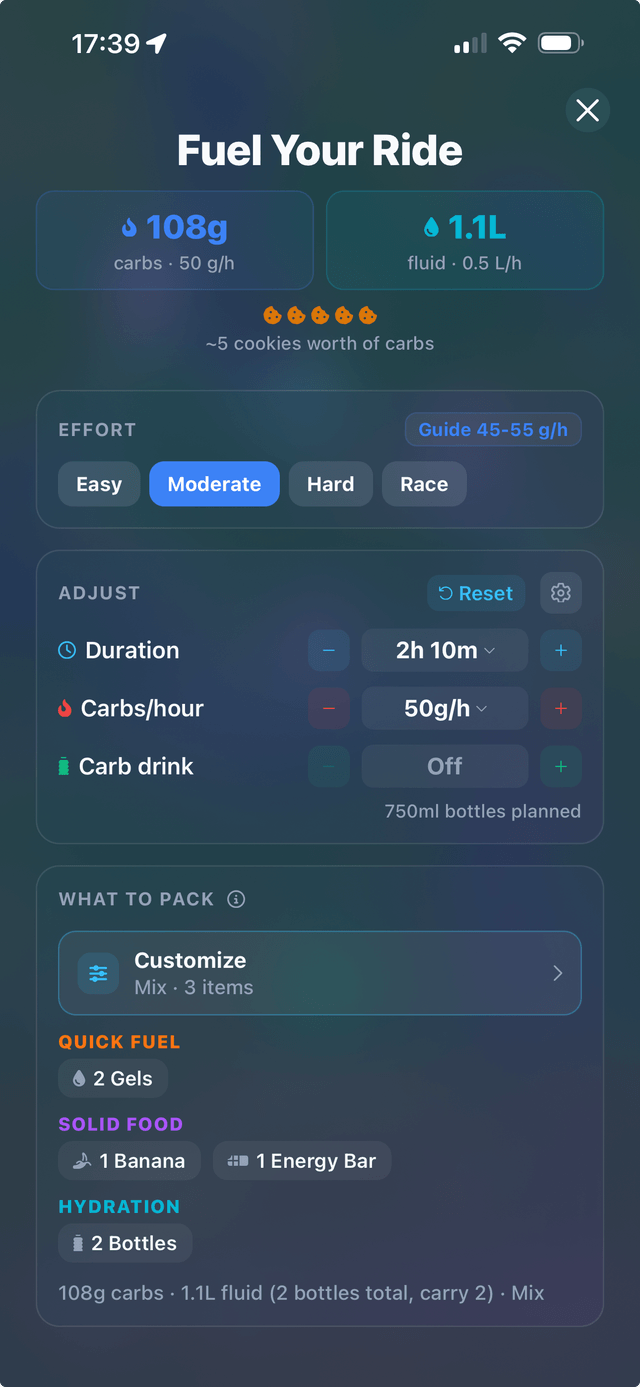
Fuel Your Ride uses your route distance, elevation, estimated duration, activity type, effort, average temperature, humidity, wind, bottle size, carb drink setting, and your selected food profile.
It starts with effort-based carb ranges, adjusts fluid around temperature and conditions, and turns the result into bottles plus a pack list. If the ride needs more bottles than you can carry, the next question is obvious: where can you refill?
The important bit is not the exact number. It is noticing early that the ride needs two bottles and one refill, not one bottle and optimism.
Limits and sources
It is meant for planning, not precision nutrition. Gut tolerance, sweat rate, medical needs, and what you ate before the ride are still personal.
Reference notes: the carb and fluid ranges follow common endurance-sports guidance from the ACSM / Academy of Nutrition and Dietetics / Dietitians of Canada position statement and the ISSN nutrient timing position stand, simplified into app-friendly planning ranges.