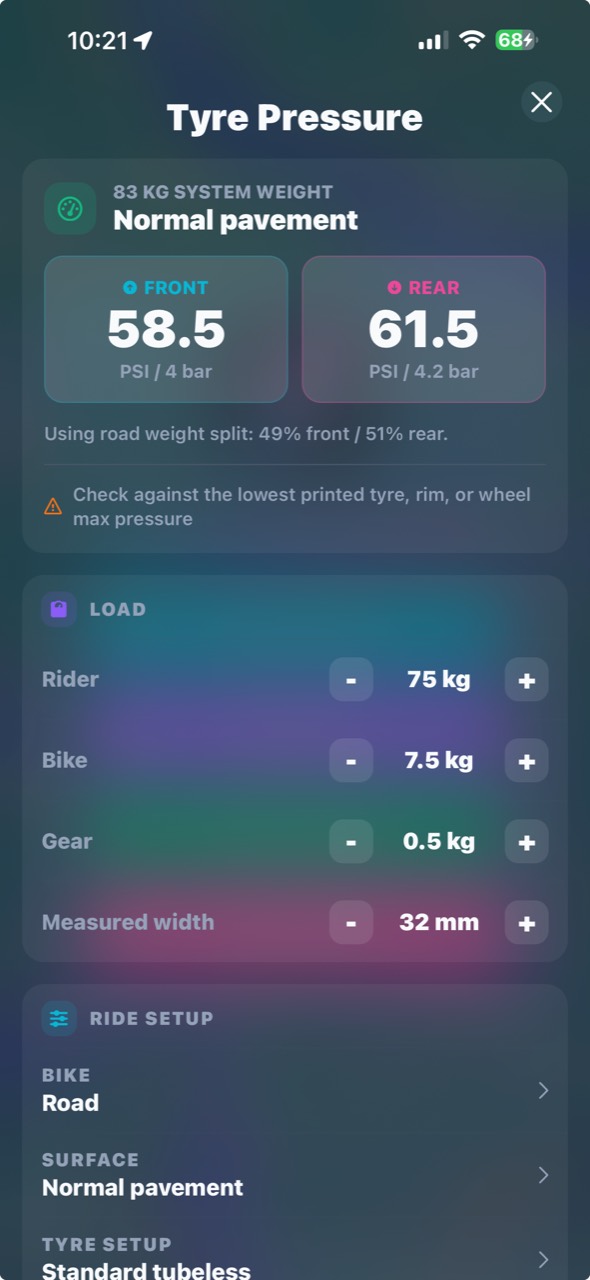
Start with the weight the tyres actually carry.
Pressure is mostly about load, air volume, and terrain. A 32 mm road tyre under a light rider does not need the same pressure as the same tyre under a loaded bikepacking setup.
Think in three buckets:
- Rider weight: the largest part of the load, and the one most calculators need first.
- Bike weight: frame, wheels, bottles, bags, lights, tools, and anything bolted on.
- Ride gear: extra clothing, cargo, food, full bottles, and the bits that change from one ride to the next.
Measured tyre width matters more than printed tyre width. Rim internal width and casing shape can make a "30 mm" tyre measure 31, 32, or more. Use a caliper if you can.
Wheel diameter is a smaller input than load or measured width, but it still changes the air volume and contact patch. Use the wheel size actually fitted to the bike: 700c/29 in, 650b/27.5 in, or 26 in.
Rougher surfaces reward lower pressure.
On glassy pavement, a firmer tyre can feel quick. On worn chipseal, broken pavement, or gravel, too much pressure makes the bike bounce and vibrate instead of rolling smoothly. Lower pressure can improve comfort, control, and sometimes speed.
| Surface | Pressure bias | What matters |
|---|---|---|
| Smooth pavement | Higher | Speed and support without harshness. |
| Worn pavement | Slightly lower | Less vibration and better grip on poor edges. |
| Hardpack gravel | Lower | Control, comfort, and fewer skittery impacts. |
| Loose or chunky gravel | Lower again | Traction and rim protection start to dominate. |
| MTB trail | Terrain-first | Grip, casing support, impacts, and cornering load. |
Mixed routes should not be averaged blindly.
A route that is 80 percent pavement and 20 percent chunky gravel is not a simple average problem. The pavement may decide how fast you roll, but the rough section decides whether the bike stays controlled and the rims stay protected.
- If the rough section is short and avoidable, you can choose a road-biased pressure and ride carefully.
- If the rough section is meaningful, lower the recommendation toward the rougher surface.
- If the route has long gravel or trail blocks, pressure should be picked for those sections, not for the smooth transfer roads.
This is where route-aware planning helps. The useful question is not "what is the average surface?" It is "what surface will punish the wrong pressure?"
Casing and setup change the answer.
A fast supple tubeless tyre usually works at a different pressure than a heavy puncture-resistant tyre or a butyl-tube setup. Wider tyres and higher-volume casings usually need less pressure for the same load.
Front and rear pressure should usually differ. The rear wheel carries more load on most road, gravel, and mountain bikes, so rear pressure is commonly a little higher. A TT bike may be closer to even. A loaded bikepacking setup may need more rear support.
Manufacturer limits override every calculator.
Never use a pressure that exceeds the lowest max pressure from the tyre, rim, rim tape, insert, or wheel manufacturer. Hookless and tubeless straight-side rims need special care, and some tyre/rim combinations have strict limits.
Pressure check before the ride
Use measured tyre width, check both tyres with the same gauge, confirm rim and tyre max pressure, and lower pressure for rougher routes before you leave home. Recheck after sealant work or a tyre swap.
How Route Companion estimates pressure
The app uses rider, bike, and gear weight, measured tyre width, selected surface, ride pace, tyre setup, wheel diameter, rim type, and bike category to estimate front and rear pressure in half-PSI increments. For road and on-road gravel tyres it targets a tyre drop: how far the tyre squashes under your wheel load, anchored near the classic ~15%. It is derived from your wheel load and measured tyre width, running firmer on smooth, fast surfaces and softer as the surface roughens. That direction matches the evidence that rougher ground rewards lower pressure, and that being a little too low costs far less speed than being too high. Mountain-bike and very wide tyres fall back to a separate model. Bar values are derived from the rounded PSI output.
The road/gravel model is validated against Frank Berto's published 15%-tyre-drop data (as redrawn by Bicycle Quarterly), not against any single brand's calculator. The "rougher = lower, and err low" direction follows the impedance / breakpoint-pressure findings from SILCA, René Herse, and a 2024 model in Vehicle System Dynamics.
When a loaded route has surface summary data, Route Companion uses it as a surface hint. It maps detailed route labels into the simplified pressure categories and prefers a rough surface if it is meaningful: at least about 10% of the route or about 2 km. If the route has no surface summary, the surface choice is manual.
This is not yet a full mixed-surface optimizer. It does not calculate separate road-biased and rough-section-safe pressures from every segment. That is the next useful step once bike profiles and route-aware setup defaults are in place.
What this is for
This guide is planning guidance, not a compatibility guarantee. Tyre pressure depends on equipment, riding style, terrain, temperature, pressure gauge accuracy, and personal preference.
Use the app's recommendation as a starting point, then adjust after real rides. If the calculator and a manufacturer limit disagree, follow the manufacturer limit.